Grams, Scoops and Teaspoons: Measuring Colostrum Correctly
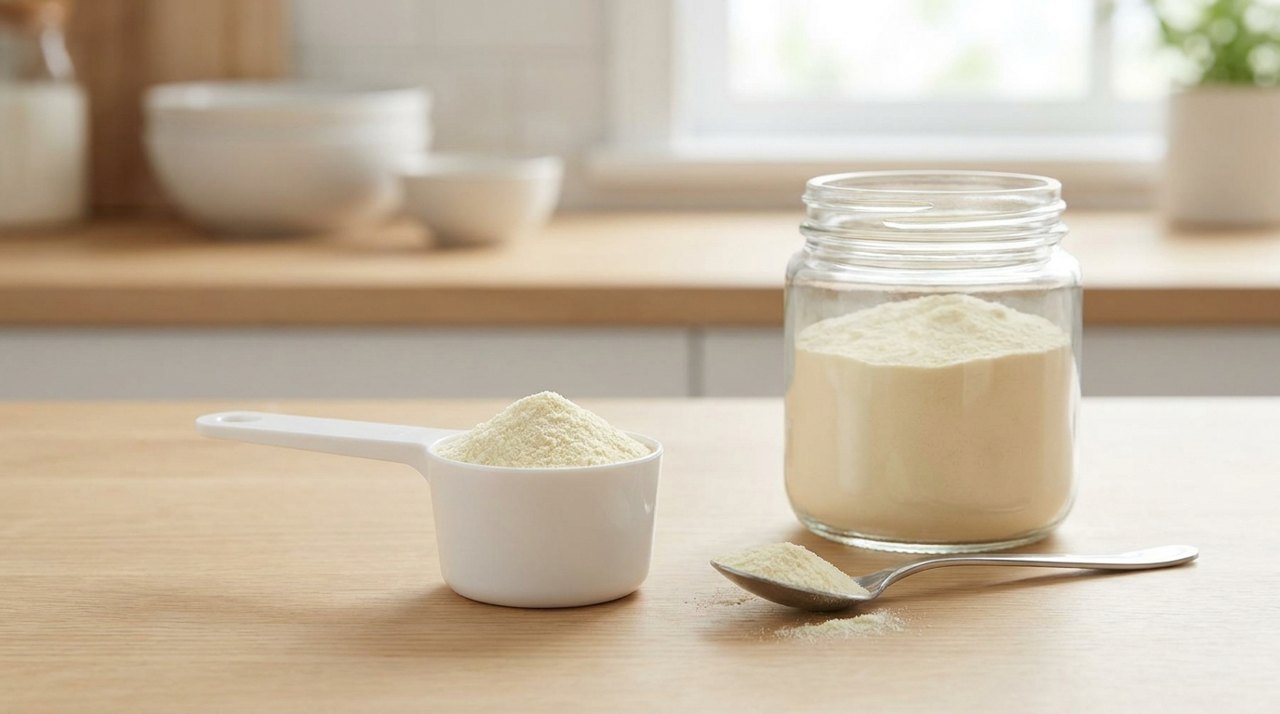
One brand's scoop holds 2 grams, another's holds 6, and a "teaspoon" of colostrum powder can vary depending on how densely it's packed. If you've ever wondered whether you're actually taking the amount printed on the label, you're not alone. Getting your measurements right matters — not because a little more or less is dangerous, but because consistency is the only way to judge whether a supplement is doing anything for you, and because colostrum is too expensive to waste on guesswork.
Why measurement accuracy matters with colostrum
Bovine colostrum is sold as a dietary supplement, and most of the research on it has used defined daily amounts — commonly somewhere between 500 mg and 20 grams per day depending on the study and the purpose. That's a wide range, and the evidence for many uses is still preliminary. But one thing the research does make clear is that studies dose by weight in grams, never by scoops or spoons. If you want to loosely follow what a study used, or simply keep your own intake steady from week to week, you need to know what a gram of your particular powder looks like.
There's also a practical cost argument. Quality colostrum powder is not cheap. Heaping scoops that are 30% larger than intended add up quickly over a month, without any evidence that the extra amount provides extra benefit.
The problem with scoops
Scoops measure volume, but labels talk about weight. The conversion between the two depends on the powder's density, which varies with:
- Processing method. Freeze-dried colostrum tends to be lighter and fluffier than spray-dried powder, so the same scoop holds fewer grams.
- Fat content. Full-fat and defatted colostrum powders pack differently.
- Settling. Powder compacts during shipping. The top of a fresh tub is airier than the bottom of a half-used one, so a level scoop from each can differ noticeably in weight.
- Your technique. A heaped scoop can easily carry 50–100% more powder than a level one.
This is why the scoop included in one product cannot be trusted in another product — and why "one scoop" only means what that specific manufacturer says it means, and only when levelled.
Shopping for colostrum? Our current best-value pick is BIOMIXA grass-fed colostrum powder on Amazon.
Typical conversions (and their limits)
The figures below are reasonable ballpark values for typical bovine colostrum powder. Your product may differ, so treat these as starting points, not gospel:
| Measure | Approximate weight | Notes |
|---|---|---|
| 1 level teaspoon (5 ml) | ~2–3 g | Freeze-dried powders sit at the lower end |
| 1 heaped teaspoon | ~4–5 g | Highly inconsistent; avoid for regular dosing |
| 1 level tablespoon (15 ml) | ~6–9 g | Useful for larger daily amounts |
| Manufacturer's scoop | Varies (check label) | Usually 1–6 g when levelled |
Note that a kitchen "teaspoon" from your cutlery drawer is not a measuring teaspoon. Cutlery spoons commonly hold anywhere from 3 to 7 ml. If you're going to measure by spoon at all, use proper measuring spoons and level them off.
How to calibrate your own scoop or spoon
The most reliable low-effort approach is to calibrate once, then use volume day to day:
- Get a scale that reads to 0.1 g. Inexpensive pocket scales work fine; ordinary kitchen scales that only read whole grams are too coarse for small servings.
- Weigh your empty scoop or spoon, or use the scale's tare function.
- Fill it level — scrape off the excess with a knife, don't shake or tap the powder down.
- Weigh three level scoops separately and take the average. If your three readings vary by more than about 10%, your levelling technique needs work.
- Write the result on the tub. "1 level scoop = 3.2 g" saves you from re-measuring, and repeating the check when you open a new tub catches batch-to-batch differences.
If you don't want to buy a scale
Use the manufacturer's own scoop, always levelled, and accept that you're trusting their stated scoop weight. That's a reasonable compromise — day-to-day consistency matters more than absolute precision for a supplement like this.
Serving size vs. daily amount
Read labels carefully: some list the amount per scoop, others per serving (which may be two scoops), and others per day (which may be two servings). There is no established "correct" dose of colostrum — studies have used widely varying amounts, and more is not demonstrably better. Most manufacturers suggest somewhere in the 1–10 g per day range. Our guide to dosage and safety covers what the research has actually tested and where the evidence is thin.
Measuring when you mix
How you take the powder doesn't change how you should measure it, but a few habits help. Measure the powder dry, before adding liquid — wet powder clings to spoons and scoops, throwing off the amount and leaving residue behind. If you split your daily amount across a smoothie and an evening drink, measure each portion separately rather than eyeballing half a scoop. For practical mixing techniques, temperatures to avoid, and timing, see our guide on how to use colostrum powder, and if you want ideas beyond stirring it into water, browse our colostrum recipes.
The bottom line
Grams are the honest unit; scoops and teaspoons are conveniences that need calibrating. Weigh your scoop once with a cheap 0.1-gram scale, level every serving, re-check with each new tub, and don't assume one brand's scoop translates to another's. Precision to the last milligram isn't the goal — consistency is, so that you can fairly judge over weeks whether colostrum is worth a place in your routine.
BIOMIXA Bluegrass Colostrum
A grass-fed, unflavored colostrum powder that balances quality and price well — our pick for the best bang for your buck. Check the current price and reviews on Amazon.